Saturday, October 21, 2017

AutoWealth and I

I thought I will also share a bit about why I decided to try out Autowealth. There are just 3 companies offering similar robo-advisory services in Singapore. Autowealth is one of them, the other two are Smartly and StashAway. I have nothing against the other two, but I was drawn to AutoWealth and I believe in fate.

Earlier this year, I had a chance to learn more about their business model from the "brain" behind the formula used by AutoWealth -- Tai Zhi. It was at an exhibition booth at Innovest Unbound and their booth was empty so I went over to ask a few questions.

I had my doubts about the company's sustainability

  • The marketing was a little bit "smoky" because anybody who had bought shares post Aug 2015 would have made decent gains, so I wasn't impressed when they marketed the 5-6% returns after a year.
  • The "brain" is honest. His IT guy - the guy who coded his brain out and did the portal - is down-to-earth. I had a fleeting thought that these guys might get conned by someone.
  • The fees are so low SGD 18 platform fee/year regardless of the number of transactions. Imagine every customer does weekly buys... lol even monthly buys, I don't know how to earn. On top of that, they charge 0.5% of Asset Under Management (AUM), which is really like a charity business.
  • Marketing hasn't been agressive, unlike their competitors, but it shows that they are down-to-earth (again) and watch their bottom line.
  • Shares are held in a custodian, so they can be easily "knocked out" of business and the customer don't need them anymore.
I went to research a bit more about the ETFs they recommended and I decided to sign up after a few months. The ETFs recommended have really really low expense ratios. I don't really care about the ETF performance because prices fluctuate and there is nothing much to compare between ETFs other than the expense costs.

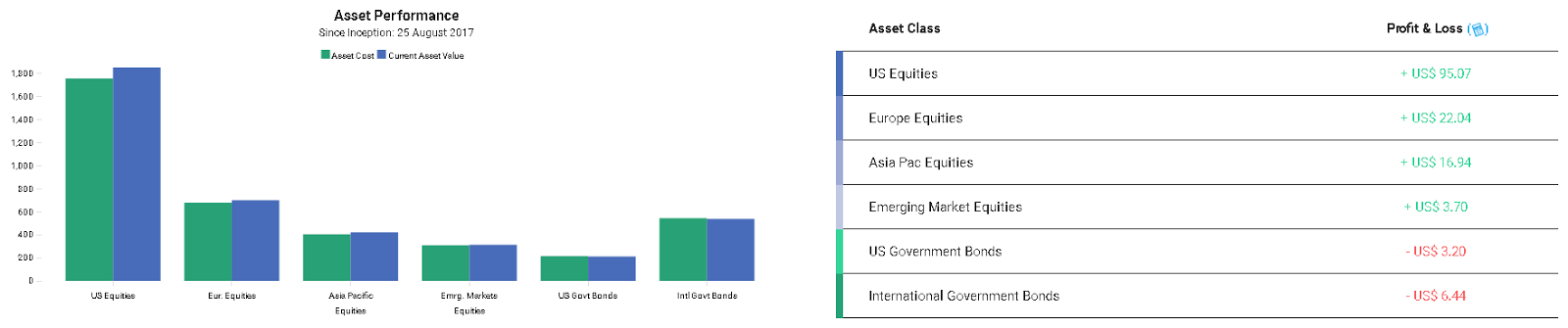
Here are some screen shots of how it looks like. I don't know if I can share it but it was one of the burning questions I had before signing up. (Seeing how down-to-earth they are, I decided that I will help them with their marketing lol...)

There is a portofolio summary.

There is a composition chart to show you that they really buy according to the ratios they showed you when you signed up.

Shows you how each ETF is doing too.
Top-up history -- this is important and it's there
There are many other screens, but I don't use them.

I have no doubt about their passion to bring investment to the masses. I still have my doubts about the company's sustainability, but I am not buying shares in AutoWealth, so it doesn't matter. If AutoWealth shuts down tomorrow, the shares are held with Saxo Capital, Power of Attorny will cease, and I have the Saxo not-so-sexy portal to still see the market prices, but I will probably have to pay much much higher transaction fees. In the meantime, all I can do is to do a little bit of charitable marketing, in hope of increasing their sustainability. I will definitely increase my AUM with them to about 10% of my portfolio when US equity prices moderate a bit. For now... I am happy to see just 1% of my portfolio grow at a crazy 0.5% per week.

List of ETFs invested:
  1. Vanguard Total Stock Market Index Fund ETF Shares (VTI) expense ratio 0.04%
  2. Vanguard European Stock Index Fund ETF Shares (VGK) expense ratio 0.10%
  3. Vanguard Pacific Stock Index Fund ETF Shares (VPL) expense ratio expense ratio 0.10%
  4. Vanguard Emerging Markets Stock Index Fund ETF Shares (VWO) expense ratio 0.14%
  5. Blackrock iShares 7-10 Year Treasury Bond ETF (IEF) expense ratio 0.15%
  6. Blackrock iShares International Treasury Bond ETF (IGOV) expense ratio 0.35%

Thursday, October 5, 2017

What did I buy in Sep 17?

SIA Engineering
Prices continued to fall, especially after the announcement that it will be removed from the ST Index from 1 Oct. On 4 Oct, prices gapped down on news that JP Morgan was selling its 38.8M stake in SIA Engineering. I bought more at $3.30 and $3.20. $3.20 was the previous low in the Aug 2015 "flash crash". Strong balance sheet and monopoly nature of business are the main reasons for me to buy. I will buy more if prices fall below $3.05, another 5% to cover a year of dividends.

SPH
I staked my money at my mouth and bought at $2.76 and $2.62. Prices fell to a low of $2.54 but did not hit my next queue at $2.48. Recently prices have been hovering around $2.70 so I am not taking any further action. I was also comparing SIA Engineering and SPH, and preferred to place more money in SIA Engineering because of its strong balance sheet, doesn't mean that SPH is a better stock because it is still in the ST Index. Did you know that the co-owners of the ST Index are SGX and SPH? Will SPH be removed from the index? I don't know.

Saturday, August 26, 2017

What did I buy in Aug 2017?

The previous posts
What did I buy in May 2017?
What did I buy in Jun 2017?

I bought SIA Engineering again in Aug after it fell more than 15% from its 1-yr peak in Jun. I sold SIA Engineering in Jun 2017 after the 25% run-up in price. It's ~$3.50 now and I feel that it is a good price to enter and accumulate more on further price weakness (i.e. $3.40).

I bought Japan Foods in Aug by luck. Someone sold down the share to 40 cents from 43 cents and volume was very low, so I managed to get the share. I had been in the buy queue at 40 cents since May. Basically, I submitted a buy order that had a good-to-date for the whole month so that I don't have to submit orders everyday.

I also bought QAF in Aug after its price fell 25% recently to ~$1.20 after a drop in profits. ($1.585 in Feb 2017) I was attracted to its low Price Earning Ratio (PER) of 7 and stable recurring income from its food manufacturing business.


Stock Review: Singapore Press Holdings (SPH)

SPH closed at $2.76, around its 5-year low. After SPH announced its drop in earnings every quarter, SPH will fall by about 20 cents. The drop became sharper after 31 Jul when it was announced that Ng Yat Chung, ex-NOL CEO, would become the SPH CEO wef 1 Sep 2017. Neptune Orient Lines (NOL) was sold to France CMA CGM and majority shareholders probably lost money.

Many people remember Ng for the wrong reasons, so any price drops beyond fundamentals are good opportunities.

Earnings per Share and Dividends
In Q3 financial report, ended 31 May 2017, YTD Q3 (i.e. Q1+Q2+Q3) Earnings per Share (EPS) is 8 cents, compared with 12 cents in 2016. Earnings for Q4 is expected to be higher due to recognition of 701 Search divestment gains, which will bring the EPS up to (estimated) 16 cents.
Extracted from SPH Q3 Financial Report page 24
Dividends had been steadily falling, from 24 cents in 2012 to 18 cents in 2016. Meanwhile, prices had been mostly kept above $4 earlier, in 2016, SPH spent most of its time around $3.50. (See Annual Report 2016) Dividend payout ratios had been exceeding earnings, which means SPH has been digging into its savings. I disagree with payout ratios above 90%, so my estimated upper cap on the dividend payout based on estimated EPS is 16 x 90% = 14.4 cents (@5% yield = $2.88). If I were a bit more conservative, I will estimate the dividend as 12 x 90% = 10.8 cents (@5% yield = $2.16). 12 cents as EPS is assuming there is no divestment gain.

Extracted from SPH Annual Report 2016
Income sources
As the media business is transforming, SPH can choose to reinvent media, or choose to close its media units and become a property developer. In any case, we don't have much control over what is considered their core business.

My re-representation of data from SPH Q3 Financial Report page 5

The good thing about SPH is that they hold valuable land assets (S$4B in value).
  • SPH REIT
    • Paragon
    • Clementi Mall
  • Seletar Mall
They have 2 condo development projects
  • Sky@eleven (2010)
  • Mixed commercial and residential project at Bidadari, next to NEL Woodleigh MRT (est. 2021)
Recurring SPH investments that I like
25 Aug 2017 - SPH will write-down S$31M in it's Mediacorp TV investments, following Mediacorp's decision to cease print edition of newspaper TODAY.

My views on SPH
When almost every analyst report recommends a sell on SPH, I am recommending a buy. I currently hold 200 units which I bought on a wimp at $3.90 in the 2015 market correction because they bought 20% stake of Mindchamps. I had since regretted hence had not added any. I will buy SPH at $2.76 as it's at a 5-year low and has a projected 5% yield based on a reduced annual dividend of 14 cents. The price might go lower, and my entry points will be every 5% to cover the 5% dividend opportunity. 
  • $2.76 - 2000 units
  • $2.62 - 1000 units (-5%)
  • $2.48 - 1000 units (-10%)
  • $2.34 - 1000 units (-15%)

Thursday, June 22, 2017

What did I buy in Jun 2017?

The previous posts
What did I buy in Nov 2016?
- What did I buy in May 2017?

I bought Silverlake Axis at $0.53 in late May. The price fell to near its 1 year low ($0.48 was lowest) and the yield looked attractive 5.6% assuming a 3 cent/year dividend. The business model was heavy on IT maintenance projects with banks which was a rather stable economic moat. However, before you plonk it your cash, be wary that they had a scandal in 2015 -- alleged inflated profits. The share price fell to as low as 35.5 cents on 26 Aug 2015.

Silverlake Axis past 3 years.

I sold some of my SIA Engineering shares in Jun. In the past 6 months, its price had risen 25%. If you recall, I bought some SIA Engineering in Nov 2016. The only reason why I sold some shares was to free up cash to invest in other companies.

I bought Design Studio shares in Jun. It has an attractive yield of 11% assuming a 6.5 cent/year dividend. The business model is doing interior design and renovation projects for condos and hotels. This share caught my attention because I regretted not buying when I saw it 6 months ago. It's price jumped from 46 cents to 64 cents recently. In any case, regretting doesn't justify why I bought. Overall, its business looks sustainable as more buildings are doing renovation, especially when occupancy is rising and rental yields are falling, so landlords usually will zhng their rooms to attract tenants. Before you plonk your money into this share, just to let you know, it's just 2% of my portfolio that is taking this risk. I would love to just throw more money at a 11% yield but I am unsure whether its a value trap.

Saturday, May 20, 2017

What did I buy in May 2017?

The previous post was What did I buy in Nov 2016?

I was queueing for a few stocks (Japan Food, Chuan Hup, Figtree) in Dec-Jan but did not manage to buy any. As the price went up and up, I sat out of the market.

Recently I sold 25% of my DBS shares at $20.80 to return some cash to my warchest. In 1 month, DBS share price rose from $18.60 to $21.00 or 13%. It was also the 5th wave of rises since its lowest point of $15 in Nov 2016. $15 to $21 is a 40% increase. I will never know if the prices will fall back to it's low of $13 or rise further to $26 (100% increase). 5 waves of rises and 40% in 6 months is certainly a little feverish to me. I will just sit tight and see where the waves are heading.

The rest of my portfolio remained the same. I did not buy any stocks.

DBS technical chart

I also did a stock take on my portfolio distribution as I had not calculated it since a year ago. Effective yield is 4.1% p.a. For all the effort put in, I am just matching the CPF Special Account (SA) yield of 4%. Excluding Keppel Corp, the yield is 5.13%. 20 years from now, I hope (and I know hope cannot be eaten) that I can tell myself that I made a right bet with Keppel Corp.


Sunday, April 16, 2017

Book Review: Lee Kuan Yew by Allison and Blackwill

- The Grand Master's Insights on China, the United States, and the World. Interviews and selections by Graham Allison and Robert D.Blackwill with Ali Wyne. Belfer Center Studies in International Security. Published by The MIT Press.

This book focused on international politics and what Lee Kuan Yew's thoughts of the future were. There were a few key ideas which might help the retail investor decide whether to bet for or against the Singapore economy.

Future of welfare states
In general, he believed that welfare states would pass on more and more debt to the next generation just to implement popular policies that win popular votes. For example, the US and most European countries are severely in debt funding welfare. It incentivises the unemployed to remain jobless, and disincentivises the hardworking workers with 40-50% tax on their income. This will only stop when something drastic enough happens, for example, bankruptcy or major government changes.

Future of corrupted states
This is a no-brainer, but these countries will continue to remaining in their third world or developing status until the government puts in proper order and law. He explained it that order had to come before the law is in place to enforce it. India was an example of having the law but no order. Brazil, Russia, China, were other corrupted countries whose growth had been sabotaged by corrupted leaders.

Future of globalisation
He believed that technology and air transport advancements had offered everyone with equal opportunities to sell goods and services. It will continue to change the way businesses operate and how governments manage their countries. Protectionism will be the downfall of a country. Capitalism is necessary to motivate the good to do better and more for the country. Talents will leave their home country if they don't like their government.

China and US
China will have no reason to want to be a superpower. China is just progressing peacefully. China and US relations will had big impact on every economy. The best outcome is to have good trade relations between the two.

Threat of Terrorism
He mentioned that the threat had been seeded since the 1970s and will be difficult to eradicate. The solution he offered was for the Moderate Muslims to counter the extremist Islamist views being taught in schools.

Future of Singapore
Singapore's future depends on its ability to continually retain talent to run the country. The government needs to build an environment where investors and employees want to be in. The innovative spirit needs to be fused into the young, from young, at home and in school. The future workforce is one that continuously learns and adapts.

I am now interested to read the book From Third World to First. This book is not really a propaganda-type of book. It is written objectively, and perfect for anybody interested to learn about international politics. I am still betting my money on Singapore's economy, by buying Singapore stocks, and also choosing companies which have overseas investments. There is definitely a lot of economic potential in China and India after their leaders get their act together.