Sunday, December 13, 2015

Saving my ILP - Part 5

This is a continuation from Part 1, Part 2, Part 3, and Part 4.

When it came to reducing the insurance components of my Investment Linked Policy (ILP), I learnt that I had to still pay for the minimum death benefit of $170,000. The premium is $126 at 34 years old, increasing to $14,600 at 85 years old. Over 50 years, the total premium is $164,000, which is close to the death benefit. This more or less is a rough gauge how ILPs calculate the premiums. However, if I live beyond 85 years old, the premium for the next 10 years will grow at an exponential rate. I would have to pay $16,000 at 86 years old and $33,000 at 95 years old. The total premium over that 10 twilight years is about $240,000!

Initially my calculations were against a $80,000 death benefit. After revising the death benefit to $170,000, which is double, the benefits were not that far off, probably because there is still sufficient runway to benefit from effects of compounding.

$80,000 death benefit: breakevens at 3% annual return over 60 years
$170,000 death benefit: breakevens at 4% annual return over 60 years
I went ahead to submit my application to remove the Critical Illness and Early Critical Illness insurance components. The $170,000 death benefit includes Terminal Illness and Total and Permanent Disability (TPD). I also removed the riders for female illness, medical reimbursement, and accident. 

However, in view of the high up front cost of an ILP, I decided to retain the crisis waiver rider, which cost 10% of the premium paid or $269.90/year. I estimate that I will need to keep it for another 15 years (or when the cash value exceeds the premiums paid, whichever happens earlier) where all ILP premium payments will be waived for life in the event of Critical Illness. If I were to terminate the ILP now, I will lose about 8k. Most of the agent's commissions are paid from the first 3 years' premium. As I am in the 4th year, the additional loss I incur is marginal. If I terminate the ILP next year or any other year, I will probably lose about 10k. Going back to the calculations, the ILP will break even at year 18 assuming a return of 3% or 4%. Difference is slight because the compounding effect can only be seen after 30 years. As such to mitigate any losses from early termination of the ILP plan, I must have enough money to sustain it. For now, I will treat the  $269.90/year as a "Critical Illness term plan" that pays out $2,699/year for life as a benefit. It is expensive and I will definitely terminate it when I have secured my passive income flow.

What I had learnt: I bought it with the intention to diversify my investment portfolio. This product was created with the US tax system in mind where the capital gains from investments and estates of dead persons are taxed. The rich people bought such ILP plans to avoid tax legitimately. Insurance payouts are not taxed. This plan works around the insurance policy requirement where 1% of the value must be used to buy insurance. In Singapore, there is no estate or capital gain tax. As such, there is no need to buy an ILP to avoid tax. I do not mind buying a whole life plan, like this ILP I bought, but I think that it is not necessary if I can manage my cash flow well. I will still prefer the ILP over fixed term whole life plans where you pay a fixed amount for 10 or 15 years, and it pays out a fixed death benefit upon death. The ability to allocate 1% to insurance and 99% to investment makes it a really powerful investment vehicle to force one to save, provided one has life's runway to accumulate and benefit from effects of compounding.


Sunday, December 6, 2015

Stock Review: Dairy Farm International Holdings

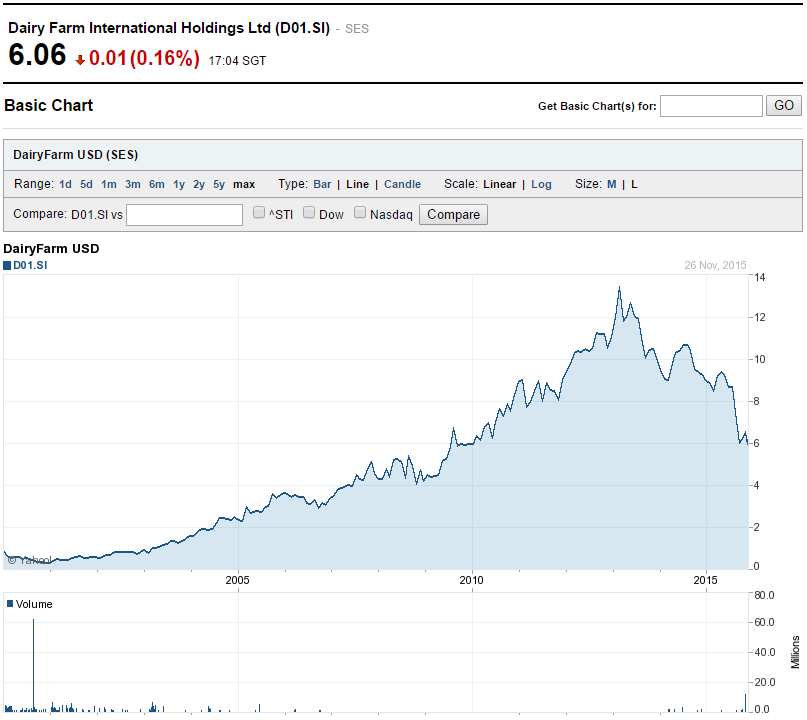
The share price for Dairy Farm had been falling over the past few year. In fact, it has fallen by 50% from its peak in 2013. However, at the current price of US$6, it is still much higher than its price more than 10 years ago.
Historical stock prices for Dairy Farm

Historical USD/SGD exchange rates for the past 5 years

Assuming that at its peak of US$13, and an exchange rate of 1 USD=1.2 SGD, it briefly translated to S$15.60 to buy a unit of share.

Assuming a present day exchange rate of 1 USD = 1.4 SGD, it briefly translates to S$8.40 to buy a unit of share now. This simple calculation exercise shows that the exchange rate fluctuations are independent of the share price movements.

Dairy Farm has a Scottish beginning. The current management belongs to the 5th generation of the Keswick family that also manages the other conglomerates Jardine Cycle & Carriage, Jardine Matheson Holdings, Jardine Strategic Holdings.

Cash flow has been positive every year until Dairy Farm decided to plonk US$925M in a mega investment (20% stake) in Yonghui Superstores in Aug 2014. According to the bloomberg article's research, Yonghui is the 5th largest hypermarket with a 4.6% market share. The two largest chains have 14% market share each. A year later, in Aug 2015, Dairy Farm plonked another US$210M into Yonghui's rights issue.

There are many ways to enter a China market. They could have started small by launching their own international brand (difficult route), or they could have bought smaller stakes with a fraction of their free cash flow (easier route) which has been their typical investment appetite. Taking up a huge loan to finance a huge investment certainly seems a little desperate.

Based on the historical price charts, assuming that Dairy Farm bought shares at an average of of RMB7, dividend yield is estimated at 1.7% (assuming 12 cents dividend). Yonghui's share price peaked at RMB 16.96 this year.

For me, it is really a stretch to realise the gains of a US$1.135B investment at a 1.7% yield. Just for the sake of cost-benefit-analysis, I will assume that the investment is fully financed by a loan. Bank fixed-term loans rates are at an average of 2.7% which actually makes this investment seem like a -1% yield investment (-US$11.35M/year). There has to be some other benefits to this investment that I am not seeing.

At a price of US$5.81 (4 Dec), Dairy Farm has a never-seen-before attractive 5.5% yield. It is tempting, but the thought of Yonghui always eating into cash flow is worrying. There are currency exchange risks as well if we would like to buy a stake in Dairy Farm. Events that will cause Dairy Farm's prices to continue to slide:

  • USD appreciating against the RMB and SGD. Continual appreciation of the USD may potentially reduce Yonghui's yield rate.
  • Rising loan interest rates.
  • Losing market share to digital commerce platforms and the only solution is to reduce profit margin.
  • Lack of creative strategies to regain market share. (Of course they will not disclose their internal strategies, but I certainly have not seen any differences in the way the Dairy Farm-managed shops operate in Singapore.)

The writer does not own shares in the companies mentioned.

Friday, December 4, 2015

Looking back and taking stock

As we are approaching the end of another year, I think about the roller coaster rides and ask myself whether I could have done better.

I had been probably waiting for a correction like what happened in the later half of the year for four years. It was a case of increasing opportunity cost as the wait lengthened. At a certain point, I actually decided to stop waiting and bought some shares for income. After buying in Dec 2014, the market rallied and peaked in April before the sharp correction came in August. I regretted a little, but learnt an important lesson -- always be consistent in a strategy. If the strategy is to wait, then wait. If the strategy is to stay invested, then stay invested. I wavered and switched strategy while waiting and got a little burnt.

I used to time-the-market. I told myself that as long as I sit out and wait, one day I will catch the boat (the market crash/major corrections). My patience paid off and I caught the boat a few times, and I thought that it was the way to make money. I missed a few other boats too. What I realised this year is that time-in-market is a much much better way to make money. What I did was to continuously buy on every 5% dip or when a share price reaches a new low, but I stucked to just one strategy. I spent lots of money though because sometimes it feels like catching a falling knife.

Fortunately, because I had been waiting for two to three years, I had the warchest to spend. Unfortunately, I feel a little broke now. Some companies' prices were still higher than they were three years ago even after the market correction. It is really hard to time-the-market. Who will know the oil price will drop so much? What will think that the China market will crash by itself without impacting the rest of the world that much? Who will know that European Central Bank (ECB) will actually have negative interest rates? It is a crazy world.

After going on a spending spree, I have 20 different share counters in my portfolio now. Before that, I only had 4. My overall portfolio market value is negative though, -12%, but I am getting about 6% yield for it. The yield rates range from 1% to 10%. I decided to build my own "index fund" with a wide-range of businesses, but only selecting those I like. I cherry-picked the companies that I like and belong to the Straits Times Index (STI).

I still feel the need to have sufficient warchest to buy more if the market crashes anytime soon. After factoring in the additional income from half a year's work and the dividends collected from the new shares, I probably still have some buffer to buy a few more shares if they are really worth it.

Warchest allocation ratio based on a fixed sum.
Snapshot of portfolio distribution from CDP in Nov
Overall, I am quite satisfied that I had the guts to buy when market sentiment is bad. This gut feel is always backed by my own stock reviews (detailed analysis of the financial reports) and knowing that my warchest is sufficient, i.e. if the market crashes 40% tomorrow, I still have the money to buy even more.

Thursday, November 26, 2015

Stock Review: Accordia Golf Trust

In my first review, I mainly looked into the financial reports and the motivations of their parent company that is listed in Tokyo. At that time, the share price was S$0.70. Five months later, their share price is hovering around S$0.60. I will attribute this decrease to the overall weakness of the market, and not specific to the company. As such, does a lower price present a buying opportunity?

I decided to look into the more optimistic aspects of the future. Yen appreciation? Economic recovery after 25 years of sluggish growth? Increase interest in golf? I don't want to bet on those factors that are intangible. The only tangible aspect is the location of the golf courses, which I decided to study a little bit more.

Japan is huge. Some people believe that the Tokyo Olympics in 2020 will turn the economy around. As golf is also one of the new sports to be featured in the Tokyo Olympics, there are people who believe that it will generate interest in golf and the golf courses will be profitable.

I will sidetrack a bit to illustrate a fallacy in logical reasoning.

A: People love to watch movies
B: People find DVD rental is a cheap way to watch movies
Therefore, DVD rental shops is a good business to be in.

However, what if there is a new way of watching movies that is as cheap as the cheapest DVD rental?

A: People love to watch movies
C: People find that Google Movies/Netflix is as cheap as DVD rental
D: People find that Google Movies/Netflix is more convenient than DVD rental because they can get it instantly, without having to wait for the DVD to be available, or travel to and fro the shop or wait for the DVD to be delivered.

Therefore, DVD rental shops is not a good business to be in.

Notice how the introduction of new business models can potentially kill off a business model that was successful earlier?

Back to the reasoning for golf. Even if interest increases, more people play golf, does it mean that more people will play golf at golf courses? Are there equivilents of Google Movies/Netflix in golf?

The golf course where the Tokyo Olympics will use had been identified. Check out the wikipedia page -- Kasumigaseki Golf Country Club, which is located in Saitama (埼玉県). For those who are not too familiar with Saitama, it is not that near to Tokyo to experience a tourism/expatriate boom from an Olympics event.

Accordia Golf Trust (Singapore) has a few golf courses in Saitama. The portfolio of golf courses are published on their website. If you read the English version, click on Tokyo region. As most of Google Maps is in Japanese, I referenced the Japanese list to make sure that the words match. There are seven golf courses under Accordia. However, there are many more golf courses in the same area and in fact, nearer to the residential areas and the olympic golf course.

Kasumigaseki Golf Country Club and Tokyo Golf Club are side by side on the map
I show this picture first because on Google Maps, only Tokyo Golf Club is shown when I zoom out.

Map of  golf courses to the east of Tokyo Golf Club
Accordia's golf courses are in red, while the other golf courses big enough to be visible on the map are pink. Take note of the mountain ridges too.

Map of  golf courses to the west of Tokyo Golf Club
Map of  golf courses to the north-west of Tokyo Golf Club. This joins to the top left corner of the "west" map.
My thoughts after going through this map study
There are many many more golf courses than what I had circled in pink. Those that are still visible on the map to be circled are large golf courses. While I was browsing the map, there were many smaller golf courses that are peppered all over the place. Some were called mini-golf clubs.

The Google Movies/Netflix equivilent in golf courses could be these mini-golf clubs that are in the residential and urban areas. Assuming that interests in golf really increases, and people want more than play golf on a Wii console at home, then the next best convenient and cost effective way will be at the mini-golf clubs or golfing stations where you are sheltered from the sun and rain, don't have to pick up golf balls, and still play golf.

There will still be people who want to watch movies at the cinemas or rent movie DVDs from shops, so these businesses, if they manage to survive with good cash flow management, will still be profitable, but you will be kidding yourself if you are expecting year-on-year growth in profits.

If I were to buy a tiny stake in a golf course company, I will opt for a more pessimistic valuation model based on the land, instead of the membership fees or playing fees. I may consider buying a tiny stake in a mini-golf club if there is such a company. For now, I have not convinced myself.

The writer does not own shares in the companies mentioned.

Saturday, September 26, 2015

Stock Review: Singtel

My friend asked me what price is a good buy for Singtel. I told him I don't know, but that I am keen to buy Singtel over its competitors M1 and Starhub because Singtel still has a monopoly in the traditional telecommunication network (fixed lines used by businesses). They also have indirect ownership of the fibre broadband network through NetLink Trust (previously known as OpenNet). Starhub and M1 will not have that long-term advantage Singtel has. That is why, financials aside, from a business standpoint, Singtel has a monopoly advantage.

Growth potential
Digging into Singtel's financial report, what stands out is that Singapore contributes to just a quarter of its EBITDA (earnings before taxes, depreciations, etc.).

Singtel's EBITA by geography
Regional mobile associates include India's Airtel, Philippine's Globe Telecom and Indonesia's Telkomsel. Australia's share comes from Optus. AIMS AMP Capital Industrial REIT (another company listed on the SGX) has a 49% stake in Optus Centre. You can consider looking at that REIT if you think that Optus Centre is a good investment.

If you think that Singapore is crowded enough, I bet the developing neighbours are just as crowded. Just based on the assumption that population will definitely grow in these developing countries, we can safely assume that the growth potential (over a very long term of 10 to 20 years) of Singtel is high. Organic population growth effects take many years to materialise.

Quality of Earnings
Singtel has an impressive investment income. What I mean is income it gets from doing nothing. Ok, they probably still have to do some work, but it is basically income derived from just shareholdings. 63% earnings come from its operations (Singapore, Australia) and 37% from its associates and joint ventures. This is akin to you having a full-time job with a gross salary of $63, say per day, and at the end of the day when you go home, you have another $37 waiting for you at home. Some people call it passive income. This diversification provides a substantial cushion for localised or seasonal dropped in earnings (e.g. Australia dollar depreciation, or drop in iPhone sales in Singapore, etc.)

Singtel's EBITA by source

Stock volatility/stability
Stock volatility or stability is important to me. I personally feel that Singtel's price spread (reaching a high of $4.40 and $3.60 low in a span of 6 months) is just an effect of the wider market swings, so I am not concerned. The Straits Times Index had a 20% price spread as well.

Singtel's stock price changes
What I am more interested in is who the price swingers are. Flipping through the financial report, we will see that the top 20 shareholders own 97% of its shares. There is also stock options granted to staff and there are activities every month. What this means is that the people who are buying and selling everyday on the SGX are likely day traders, small fries looking for long-term investments (like me), or staff who want to cash out their stock options (of course they have to pay tax on their gains too).

The daily volume has been in the range of tens of millions in the past few months, which is small, compared to the approximately 16B shares in total. 3% of that is 480M. If you see 20M shares changing hands on a day, it's only a very small portion of investors.

Singtel's Top 20 shareholders
So if you can accept that price will fluctuate because of the profile of sellers, then you should not worry about the price you pay.

Assuming a dividend of 16.8 cents (an payout has been consistent), and it's last closing price of $3.64, a yield of 4.6% is decent. The market price will likely follow the STI trends, i.e. if STI drops by another 5% from 2830 to 2690, then we can expect the price to drop from $3.64 to $3.46. Similarly, if the STI rises, then the price will rise. So the more important question is whether you are happy with the 4.6% yield based on the current price.

Singtel's dividends over the past 6 years
A buy plan that I may consider that costs ~$7,000 with eventual average price of $3.46 for 2000 units:
Buy 500 units at $3.65
if the price drops by 5%, buy 500 units at $3.46
if the price drops by 10%, buy 1000 units at $3.29
if the price goes up, just be contented that I had bought some and wait for the next opportunity.

The writer does not own any shares mentioned.

Saturday, September 12, 2015

Stock Review: If I were to pick a Commercial Trust

So many candies... which to pick?

Some people buy a stock based on its price vs past 1 year, vs what they previously paid for, vs what the IPO price was, vs dividend yield, vs price-to-book ratio, etc. I have a preference for stocks that have sustainable income, and this can mean monopoly in industry, selling of goods or services that are daily necessities, companies the country cannot do without.

I had (long, long ago) divested stocks in Capital Mall Asia (2009) and Mapletree Commercial Trust (2013) shares that I got in the Initial Public Offering (IPO) after locking in capital gains of 25%, mainly because I feel that online shopping puts a strain on retail shops and it's impossible to continuously increase rents by 10%.

Commercial trust broadly includes office space, retail space and convention/exhibition space. Today my focus is on office space.

If I have only $5,000 to spend on commercial trust shares, and all the yields are attractive -- 6 to 7% -- which will you choose?
  1. CapitaLand Commercial Trust (CCT)
  2. Keppel REIT (K-REIT)
  3. Fraser Commercial Trust (FCT)
  4. OUE Commercial REIT (OUE C-REIT)
  5. Mapletree Commercial Trust (MCT)
  6. Suntec REIT


Comparison of key attributes among commercial trusts
Debt
CapitaLand Commercial Trust (CCT) has the least debt, which means they have more room to grow or higher profit margins, depending on how you look at it. K-REIT's debt is too high for comfort and that is possibly a reason for its suppressed stock prices, given the uncertainty of an interest rate hike.

Profit Margin
Interestingly, Suntec REIT has the lowest profit margin based on my interpretation. I re-read the financial statements a few times just to make sure that I didn't read it wrongly, and I think I lifted the correct figures. As these massive landlords also invest in different properties, I must also commend K-REIT earns a profit that is 127% its revenue. i.e. it is able to generate sizable passive income, i.e. income from its investments from subsidiaries or joint ventures whose buildings are not directly managed by the company. CCT's overall profit margin is 91%, which I like a lot.

Price-to-book ratio and yield
All look attractive. MCT is the only exception trading above book value, which reflects investor confidence, but its portfolio is 70% retail and Vivocity is doing very well.

Occupancy
CCT is particularly attractive because of high occupancy and longer average leases, which means its income stream will likely be more stable than its competitors. While at a portfolio level, FCT's lease look healthy (3+ years), when you drill into the specifics, the Singapore leases are about 1.5 years, and the Australian leases are 10 years. Income from their Australia properties form a smaller percentage, hence FCT will probably have higher operating costs trying to renew and add tenancy contracts.

Overall
CCT looks the most attractive, but there is a risk of dilution of units. The dividend of 8.5 cents assumes that none of the convertible bonds (they call it CB 2017 in their financial report) will be converted to units. The total value is $175 M at a conversion price of $1.54, representing 3.9% of total units, which will mature on 12 Sep 2017. For as long as the market price remains below $1.54, it is unlikely the investor will convert to units. The dilution effect is about -10 cents in annual dividend per share.

The writer owns some units of Keppel REIT.

Thursday, September 3, 2015

To Buy or Not?

For the past one month, I had been on a mini buying spree. My friends asked me every week whether I bought anything and I was buying something every week. At the end of one month, I felt poor. I was referring to shares on the SG stock market. Money not enough. I deployed partial warchest meant for -10% correction and -20% correction all within the month of Aug 2015. The last time I deployed partial warchest for -10% correction was Dec 2014 and I had 8 months to save and top-up my warchest. No chance this time.


Theoretically, the idea was to have 100% capital control, i.e. for every $1 invested, $1 is contributed to the warchest.

When the market makes a -5% correction (benchmarked against the  highest STI reached), spend 5% of warchest, and only buy when the price drops. When the price is on the uptrend, then save money.

In the worst case scenario (based on history), when the market makes a -50% correction, spend 100% of warchest.

The rationale behind the 100% capital control is that in the event of a flash crash of -50%, I will be able to pick up stocks at half the price which will offer double protection of my invested capital in an upturn. That was the theory.

What happened between Jul and Aug was that prices dropped by 5% consecutively every one-two weeks. Following the theory, I should have spent 20% when the market was -20%, but I overspent. I spent 25%. That sucks.

So to buy or not to buy...

  1. Sit out from the market for a while to top up my warchest.
  2. Take a little risk and continue to buy little by little since -20% corrections are once every 4 years and we are still not near the once every 10 year crash cycle.
I think I will continue to buy, and my friends will continue to watch me buy. Nobody dares to buy and I like it that way (until I am done shopping).